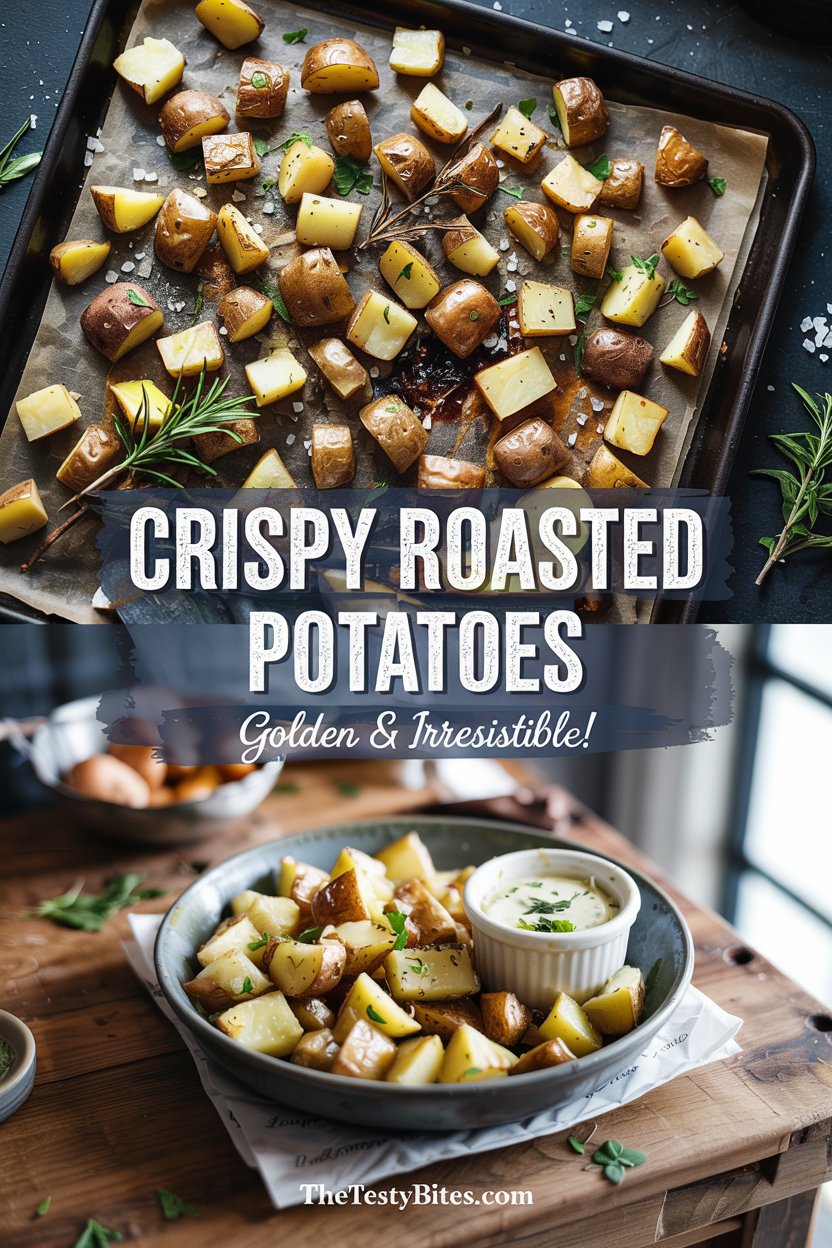
Crispy Roasted Potatoes
Parboiled with baking soda, roasted at 450°F in garlic-infused olive oil until shatteringly crisp outside and creamy inside. The side dish that quietly steals the whole meal.
Tasted & written by Rachel
Prep
15 min
Cook
1h 15m
Total
1h 30m
Serves
8
The Key
Boil the potatoes with baking soda. One teaspoon in the water raises the pH enough to break down the outer layer of each potato into a rough starchy paste. That paste hits the hot oil and turns into a shell. Without it, you're just roasting potatoes. With it, you're building armor.
David ate six of these standing at the counter before dinner was even plated. Didn't say a word. Just kept reaching. That's the review.
The secret is almost stupidly simple — you boil the potatoes first with a little baking soda, which roughens the surface into a starchy paste that turns into a shell in the oven. It's the same trick behind the best British roasties, and once you know it, plain roasted potatoes will never feel right again. The garlic goes in the oil while the oven preheats, so by the time the potatoes hit the pan, everything smells like a reason to stay home.
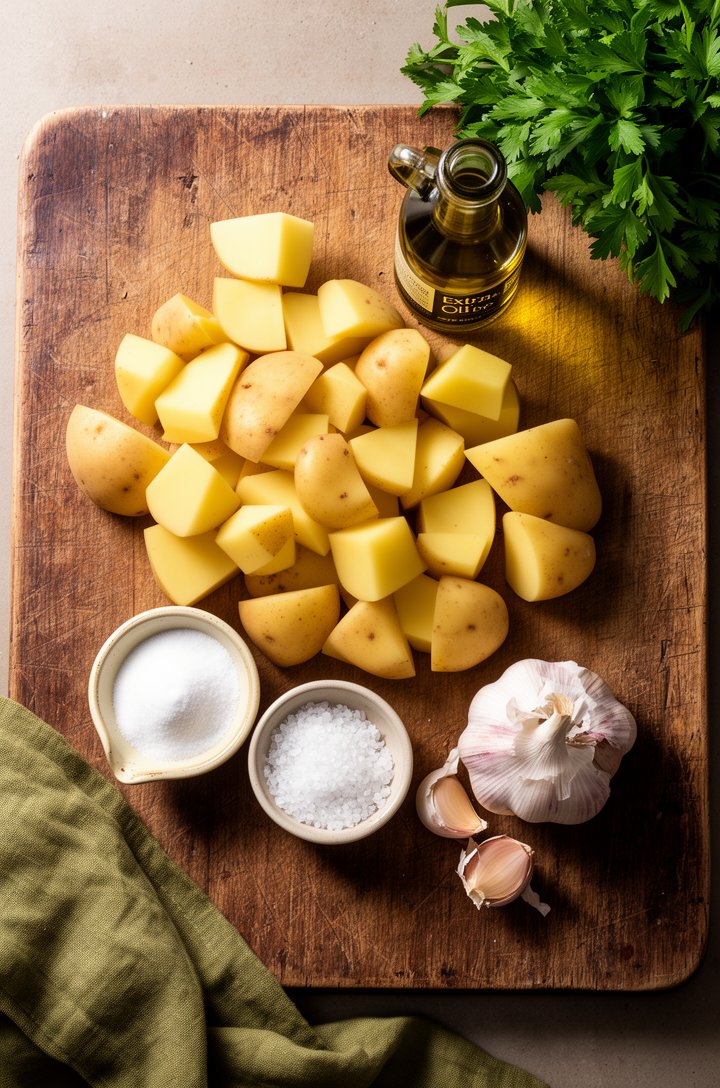
Mia calls them "crunchy clouds." Noah eats the insides and leaves the shells. Everyone's happy.
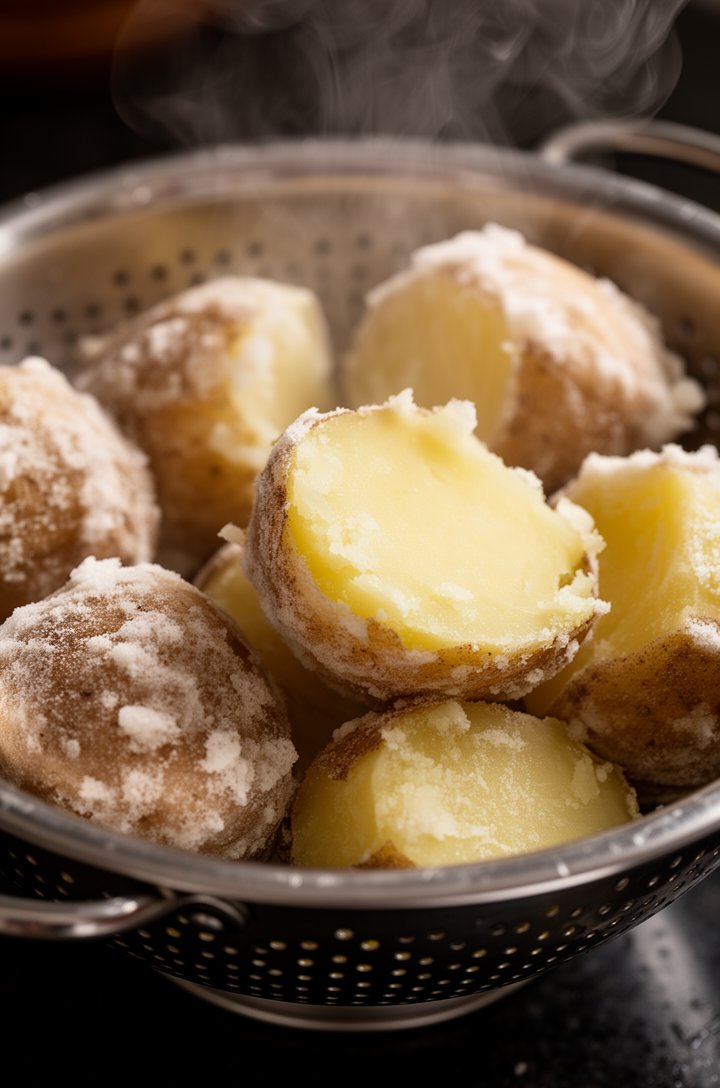
The baking soda does something genuinely clever here. It raises the pH of the boiling water, which breaks down the potato surface faster than plain water would. When you drain them and shake the colander, the outside of each piece turns into a rough, starchy paste. That paste is your future crust. It hits the screaming-hot oil on the sheet pan and immediately starts building a shell — golden, craggy, shattering.
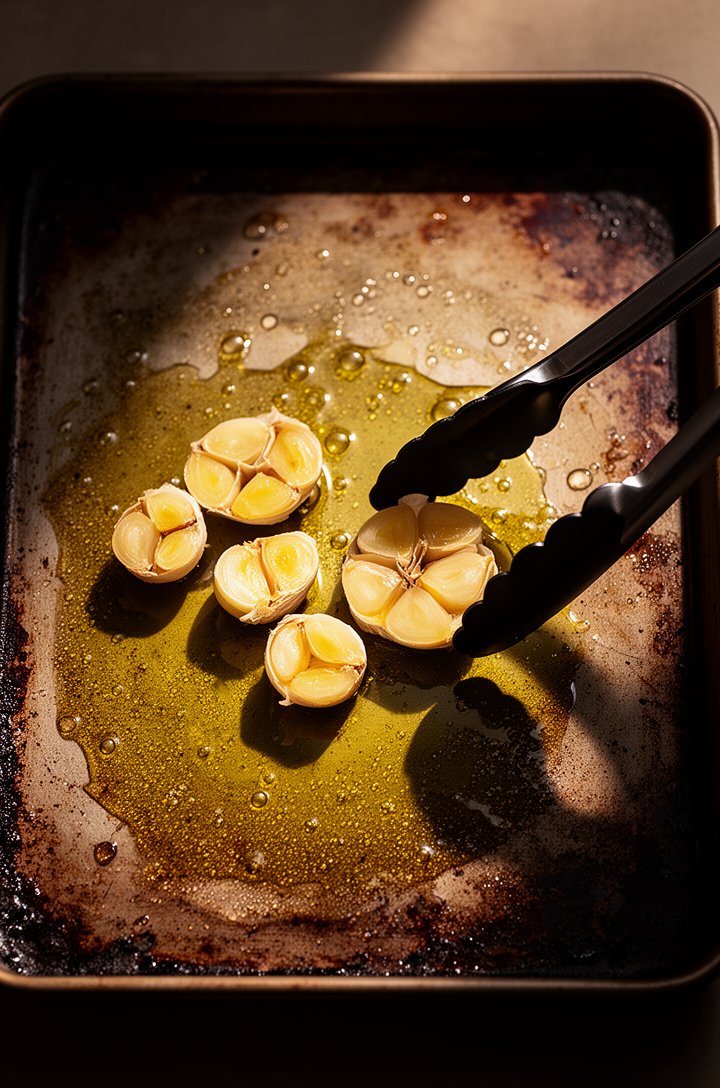
The garlic trick is worth noting. Instead of mincing it and risking burnt bitter bits, you smash whole cloves and let them swim in the olive oil on the sheet pan while the oven preheats. Ten minutes later, the oil is infused and the garlic gets pulled out. All the flavor, none of the acrid char.
Don't touch them for the first 25 minutes. I used to check at 15. The bottom would be pale, sticky, half-formed. Now I set a timer and walk away. When you come back, the undersides are deep golden and they release from the pan like they want to be flipped. That's the moment.
The second side gets another 25-30 minutes. By the end, every edge is bronzed and craggy. The inside is cloud-soft. Flaky salt and parsley the second they come out of the oven — while the surface is still hot enough to make the salt stick.
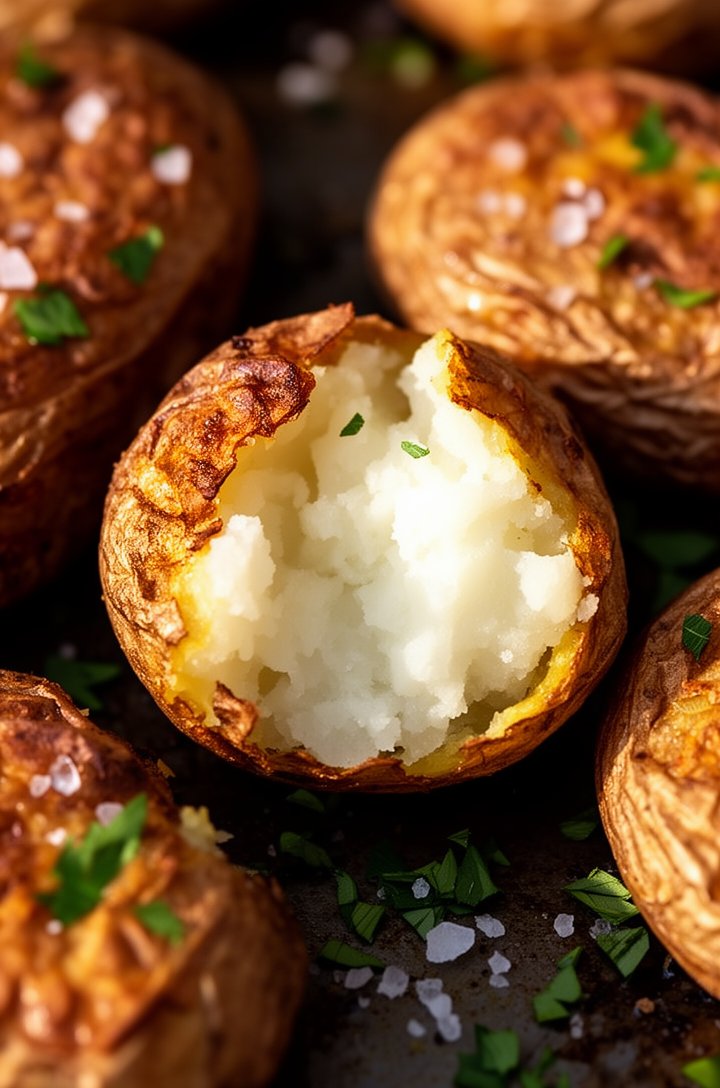
Mise en place
Ingredients
- 4 pounds Yukon Gold potatoes, peeled and cut into 1½-inch piecespeeled and cut into 1½-inch pieces
- ¼ cup kosher salt (for the boiling water)
- 1 tsp Baking Soda
- 0.5 cup Extra Virgin Olive Oil
- 3 tbsp Salted ButterOptional
- 6 garlic cloves, smashedsmashed
Finishing
- 2 tablespoons finely chopped fresh parsleyfinely chopped
- 1 to 2 teaspoons flaky salt (like Maldon)
- 0.5 tsp Black PepperOptional
The Method
Instructions
- 01
Preheat the oven to 450°F with a rack in the center position.
Done when:Oven reaches full temperature — most ovens beep, but give it an extra 5 minutes after the beep for accuracy.
- 02
Add the kosher salt, baking soda, potatoes, and 2 quarts of water to a large pot. Bring to a boil over high heat, then reduce to a simmer and cook until the potatoes are tender but not falling apart, about 10 minutes.
Done when:A paring knife slides into the center of a potato with no resistance, but the potato doesn't crumble when you lift it.
- 03
Drain the potatoes and let them sit in the colander for 2-3 minutes, shaking gently once or twice to roughen the edges.
Done when:Surfaces look dry and slightly ragged — a thin starchy paste coats each piece. This paste is what becomes the crust.
- 04
While the potatoes boil, combine the olive oil, butter (if using), and smashed garlic on a rimmed sheet pan. Place in the oven while it preheats to infuse the oil.
Done when:Oil is shimmering and garlic is lightly golden and fragrant — about 10 minutes. Don't let the garlic burn.
- 05
Remove the sheet pan from the oven. Using tongs, remove and discard the garlic cloves. Carefully add the drained potatoes to the hot oil and turn to coat evenly. Spread in a single layer with space between each piece.
Done when:Every potato piece is glistening with oil and sitting flat-side down. No overlap — crowded potatoes steam instead of crisp.
- 06
Roast for 25 minutes without touching them. Remove the pan, flip each potato with tongs or a spatula, and roast for another 25-30 minutes.
Done when:First side: deep golden crust that releases cleanly from the pan. After flipping and second roast: all sides are deeply bronzed and the edges are craggy and crisp.
- 07
Transfer to a serving bowl and toss with the chopped parsley and flaky salt. Serve immediately.
Done when:Parsley is evenly distributed and salt crystals are visible on the surface. Eat within 10 minutes — crispness fades fast.
Where it goes wrong
Common mistakes
- ✕Skipping the baking soda — without it, the surface stays smooth and you get regular roasted potatoes, not crispy ones.
- ✕Crowding the pan — potatoes touching each other steam instead of roast. Use two pans if you have to.
- ✕Flipping too early — the crust needs 25 uninterrupted minutes to form. If it sticks, it's not ready.
- ✕Boiling until soft — you want tender, not mushy. Overcooked potatoes disintegrate when you shake them and you lose the pieces.
Context
Compared to the usual
The British Sunday roast version does this with goose fat instead of olive oil and skips the garlic — pure potato flavor, maximum grease, absolutely no apologies. The Greek version uses lemon juice and oregano in the oil. Kenji López-Alt's famous take adds a Russet potato to the boiling water purely for the extra starch it sheds, which coats the Yukons in an even thicker crust layer. This version lands in the middle: olive oil keeps it approachable, garlic makes it fragrant, and the baking soda does the heavy lifting that goose fat would otherwise handle.
Glossary
Techniques used
- Parboil
- Partially boiling food before finishing it another way — here, the potatoes cook through in the water so the oven only needs to crisp the outside, not cook the inside.
- Alkaline boil
- Adding baking soda to the boiling water raises the pH, which accelerates breakdown of the potato's outer cell walls into a starchy slurry. That slurry is your future crust.
- Flaky salt
- Large, irregularly shaped salt crystals (like Maldon) that sit on top of food rather than dissolving in. Adds crunch and a burst of saltiness on every bite.
Riffs
Variations
Lemon-herb
Toss the finished potatoes with 1 tablespoon lemon juice, 1 teaspoon lemon zest, and 2 tablespoons mixed fresh herbs (rosemary, thyme, oregano). The acid cuts the richness.
Parmesan-garlic
After roasting, immediately toss with ¼ cup finely grated Parmesan and ½ teaspoon garlic powder. The residual heat melts the cheese into a savory coating.
Spicy paprika
Add 1 tablespoon smoked paprika and ½ teaspoon cayenne to the oil before roasting. Finish with a squeeze of lime.
Q & A
Frequently asked
Can I use a different potato?
Red potatoes work but won't be as creamy inside. Russets fall apart too easily during boiling — if you want to use them, cut them larger and boil for only 7 minutes.
Do I really need ¼ cup of salt in the water?
Yes. Most of it goes down the drain. The salt seasons the potatoes all the way through, not just the surface. Under-salted boiling water is the #1 reason roasted potatoes taste flat.
Can I use another oil?
Avocado oil works great (higher smoke point). Duck fat or goose fat makes them richer but heavier. Avoid regular olive oil — it smokes at 450°F.
Why did my potatoes stick to the pan?
Either the oil wasn't hot enough when the potatoes went in, or you tried to flip them too early. Let them form a crust first — they'll release on their own.
Storage
Refrigerate leftovers in an airtight container for up to 3 days. They won't be as crispy, but they're still good.
Reheating
Spread on a sheet pan in a single layer and reheat at 425°F for 8-10 minutes until the crust re-crisps. Do not microwave — you'll get sad, soft potatoes.
Freezing
Freeze fully cooked potatoes on a sheet pan until solid, then transfer to a freezer bag. Up to 2 months. Reheat from frozen at 425°F for 15-18 minutes.
Make ahead
Boil, drain, and roughen the potatoes up to 4 hours ahead. Spread on a sheet pan and refrigerate uncovered — the surface dries out further, which actually makes them crispier when roasted.
Serve with
Next to a roast chicken. Alongside grilled steak with a green salad. Piled on a plate with nothing else because sometimes that's dinner and nobody's judging. A dollop of sour cream or aioli on the side doesn't hurt.