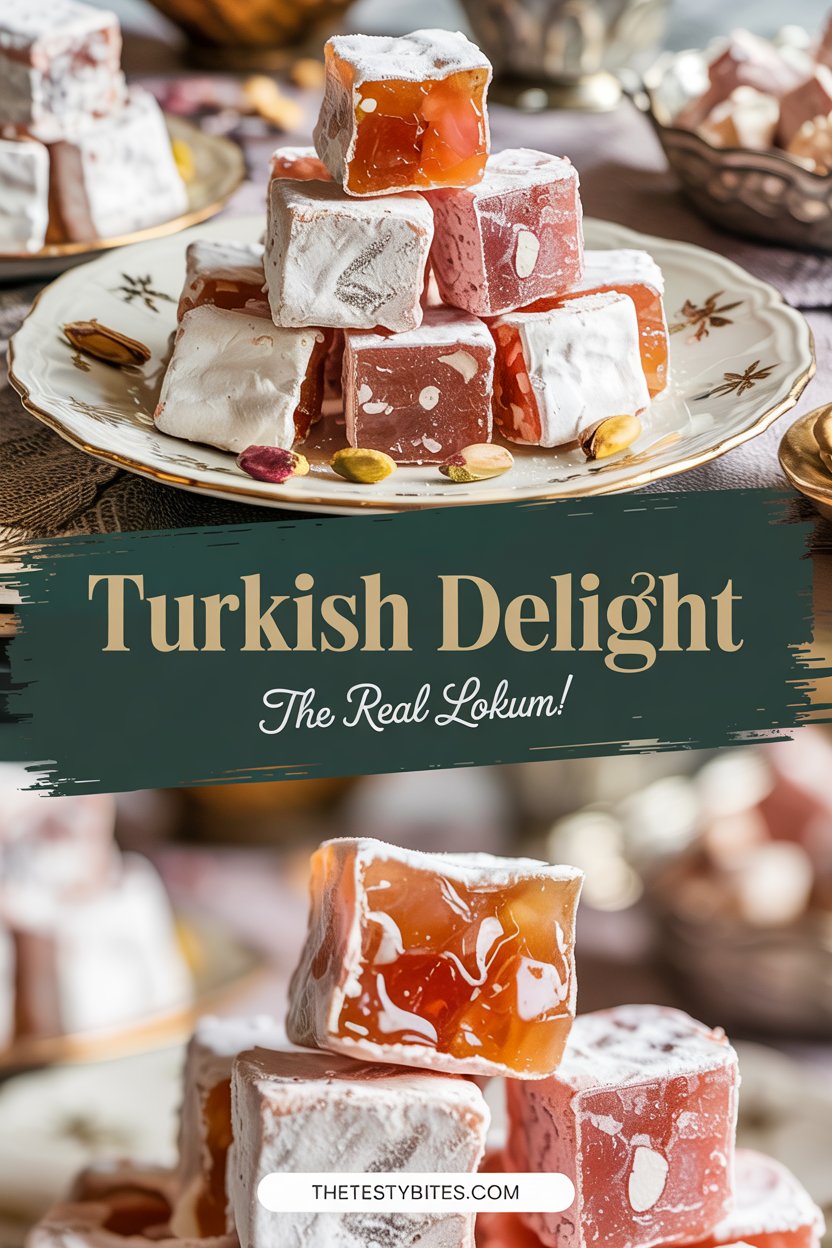
Turkish Delight (Lokum)
Rose-scented, jewel-pink Turkish delight with a yielding chew and powdered sugar shell. Two ingredients do most of the work — sugar and cornstarch — but the hour-plus simmer is what separates real lokum from gummy candy.
Tasted & written by Rachel
Prep
10 min
Cook
2h
Total
2h 10m
Serves
40
The Key
The entire recipe lives or dies in step 6. You're cooking the cornstarch slurry for over an hour on the lowest heat, stirring every few minutes. The mixture will go from opaque white to translucent amber. Use the ice-water test: dip a spoonful into ice water. If it's still soft and sticky, keep going. When it firms up immediately into a clean, chewy gel — that's your lokum.
Mia asked me to make Edmund's candy. We'd just finished The Lion, the Witch and the Wardrobe for the second time, and she wanted to know what was so good that a kid would sell out his siblings for it. Fair question.
Turns out the answer is patience. Turkish delight is five ingredients and two hours of stirring. That's it. No tempering chocolate, no pulling taffy, no candy thermometer anxiety beyond the first ten minutes. You cook cornstarch and sugar syrup together until the mixture turns amber and translucent, then pour it into a pan and walk away. The next day you cut it into cubes that look like stained glass.
Mia's verdict: she'd absolutely betray her brothers for it. Noah just licked the powdered sugar off and handed the cube back.
The thing nobody tells you about making lokum is that it's boring. Not hard — boring. You heat the mixture, stir it every few minutes, and wait. For an hour. Maybe more. The cornstarch slowly transforms from chalky white paste into something that looks like liquid amber. You'll think it's done at 30 minutes. It isn't. Every recipe that tells you to pull it at 45 minutes is lying to you — the result will be too soft and sticky. The full hour-plus cook is what gives you that clean, yielding bite.
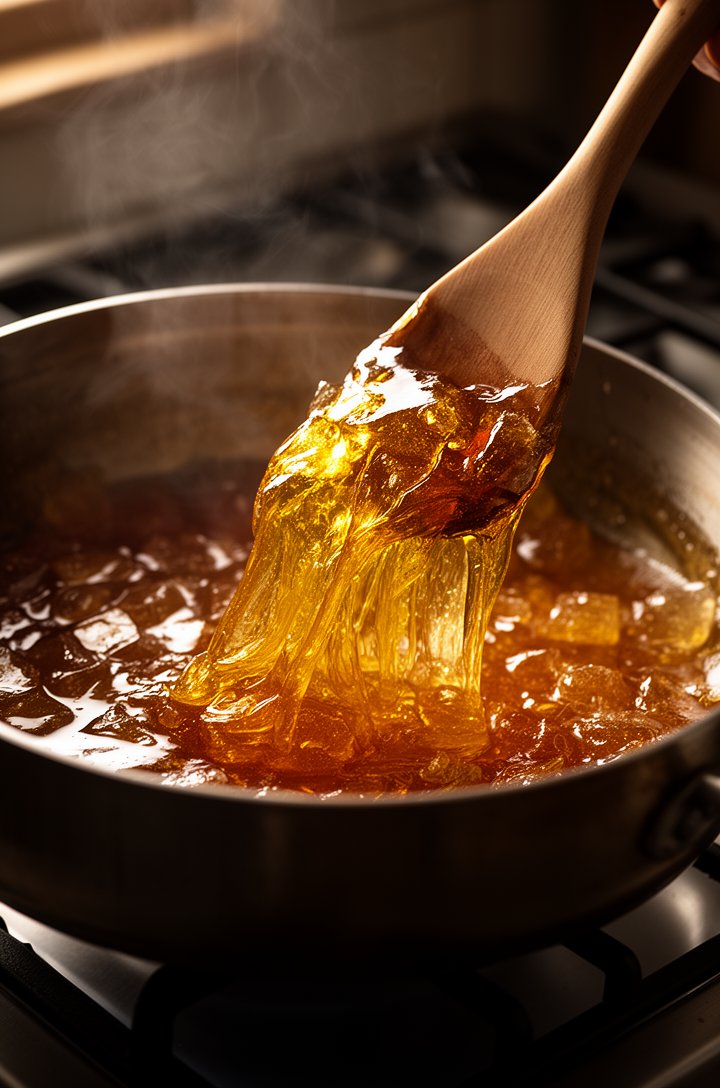
The sugar syrup takes ten minutes. The cornstarch slurry takes two. Then you combine them and settle in for the long simmer. I put on a podcast. Stir every six or seven minutes. Check your phone. Stir again. The ice-water test is your signal — dip a spoonful into ice water, and if the gel immediately firms up and doesn't stick to your fingers, you're done.
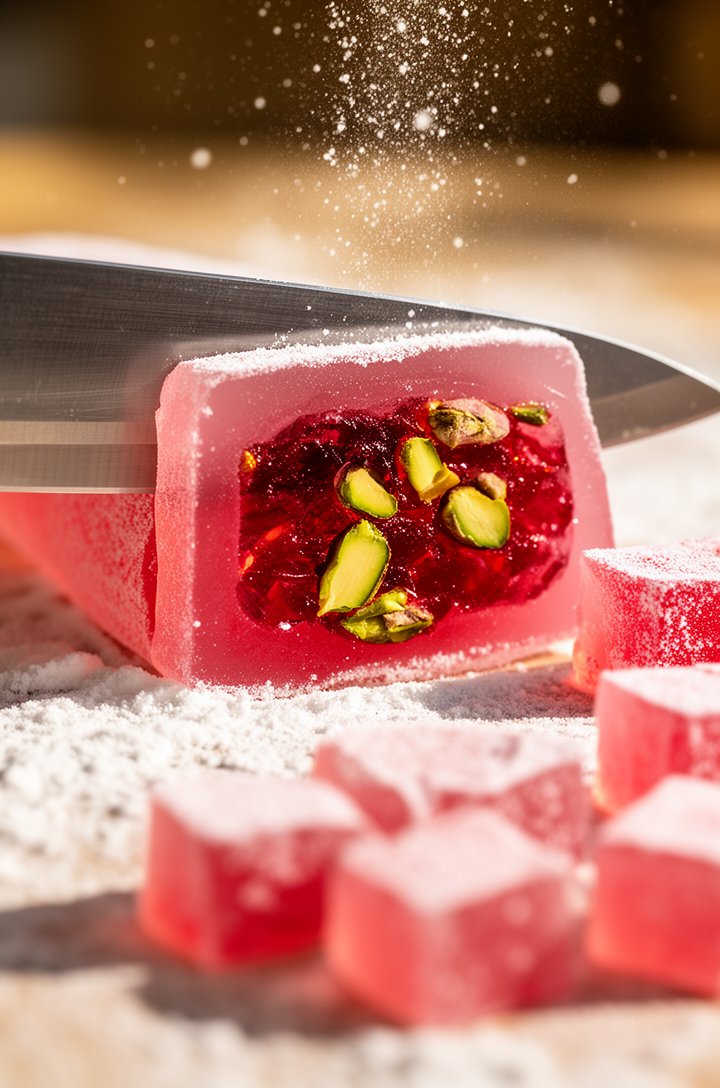
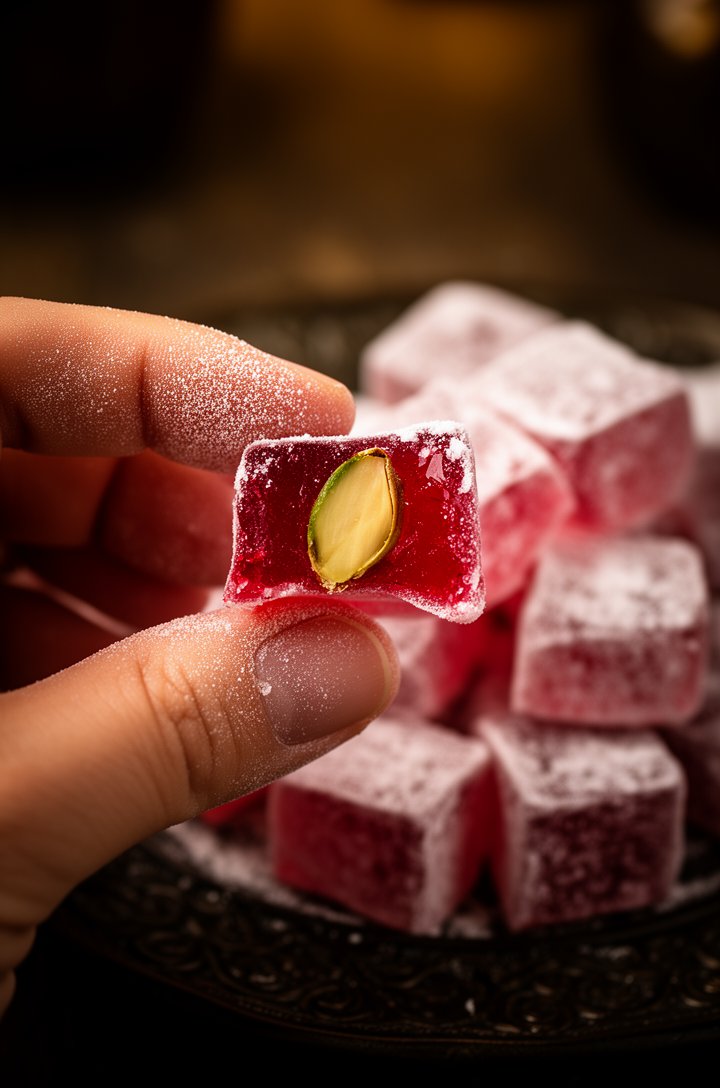
Once it's poured and set — overnight, not in the fridge — you get to the satisfying part. Cutting the slab into cubes reveals that gorgeous translucent interior. Some of mine came out pale pink, some deep ruby. The pistachio-studded ones looked like jewels.
Priya brought over Turkish coffee when she saw what I was making. Apparently her grandmother made lokum every Eid, and the only acceptable way to eat it is with coffee strong enough to stand a spoon in. She's not wrong — the floral sweetness against bitter coffee is one of those combinations that just works.
Mise en place
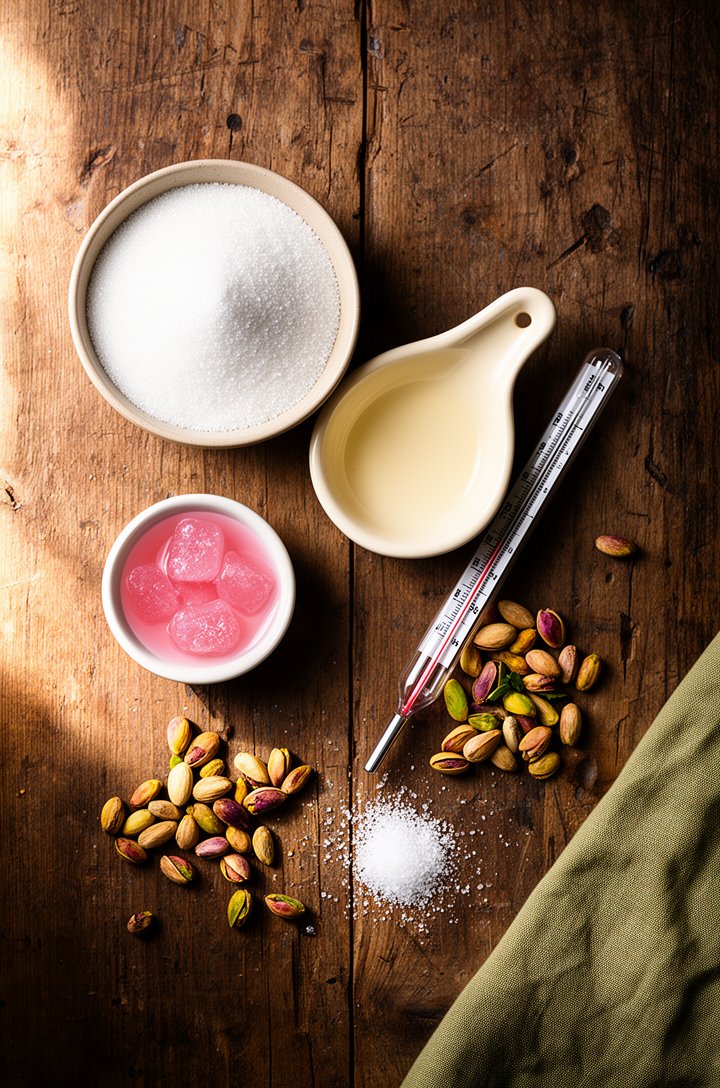
Ingredients
- 350g (scant 2 cups) granulated white sugar
- 1/4 teaspoon citric acid
- 1 1/2 teaspoons rosewater
- 10 drops red food coloringOptional
- 1/4 cup chopped pistachiosroughly choppedOptional
Sugar Syrup
- 175ml (3/4 cup) water for the syrup
Cornstarch Slurry
- 70g (1/2 cup + 1 tbsp) cornstarch
- 500ml (2 cups + 5 tsp) water for cornstarch
Coating
- 80g (2/3 cup) cornstarch for dusting
- 45g (1/3 cup) powdered sugar for dusting
The Method
Instructions
- 01
Combine sugar, citric acid, and 175ml water in a heavy-bottomed saucepan. Stir until the sugar dissolves, then bring to a boil over high heat.
Done when:Liquid is fully clear with no visible sugar crystals at the bottom.
- 02
Reduce heat and simmer without stirring until the syrup reaches 250°F (121°C) on a candy thermometer. Wipe down any sugar crystals on the sides with a wet pastry brush.
Done when:Candy thermometer reads 250°F. A drop in ice water forms a firm, pliable ball that holds its shape.
- 03
While the syrup heats, shake cornstarch and 500ml water together in a lidded jar until completely smooth. No lumps — this matters.
Done when:Mixture is perfectly smooth and milky-white with no visible starch clumps when you hold the jar to the light.
- 04
Remove the syrup from heat. Gradually pour the cornstarch slurry into the hot syrup while whisking continuously.
Done when:All slurry is incorporated and the mixture is uniform — no streaks, no lumps, no separated liquid.
- 05
Return to medium-low heat and whisk until the mixture gels and thickens dramatically. This happens fast — within a few minutes.
Done when:Mixture suddenly turns thick and paste-like, pulling away from the sides of the pan. Whisk drags with serious resistance.
- 06
Drop heat to the lowest setting. Stir every 6-7 minutes for the next 1 to 1.5 hours. The mixture will slowly turn from opaque white to translucent amber-gold.
Done when:Mixture is translucent with a medium-dark amber color, has reduced slightly in volume, and a spoonful dipped in ice water immediately firms into a chewy, non-sticky gel.
- 07
Lightly oil a 9x9 inch baking pan with neutral oil. Set aside.
Done when:Pan surface is evenly coated — no dry spots, no pooling oil.
- 08
Remove from heat. Stir in rosewater, food coloring, and pistachios if using. Work quickly — the mixture stiffens as it cools.
Done when:Color is evenly distributed throughout with no streaks. Rose fragrance is immediately noticeable.
- 09
Pour into the prepared pan and spread with an oiled spatula. Let set at room temperature for at least 5 hours, or overnight.
Done when:Surface is firm to the touch and the slab holds its shape when you press a finger into the corner. No tackiness on the surface.
- 10
Mix the coating cornstarch and powdered sugar together. Dust the top of the slab generously, then turn it out and dust the bottom.
Done when:All surfaces are completely coated — no exposed sticky candy visible.
- 11
Cut into 1-inch cubes with a sharp, lightly oiled knife. Toss each cube in the cornstarch-sugar mixture to coat all sides.
Done when:All cubes are individually coated with no sticky faces touching each other.
Where it goes wrong
Common mistakes
- ✕Rushing the simmer — pulling it off heat at 30 minutes gives you soft, sticky candy that never fully sets
- ✕Leaving lumps in the cornstarch slurry — they turn into rubbery pellets in the finished candy and there's no fixing it
- ✕Refrigerating to speed up setting — the texture turns rubbery and weeps moisture
- ✕Skipping the coating — naked cubes fuse into a solid block within hours
Context
Compared to the usual
Real Turkish lokum from Istanbul's Grand Bazaar is made with wheat starch, not corn, and cooked for 2+ hours until deeply amber and almost caramel-flavored. This recipe uses cornstarch — easier to find, more forgiving — but keeps the long cook time that separates it from the 30-minute shortcuts floating around the internet. Those faster versions set, technically, but they chew like gummy bears instead of having that yielding, almost-melting texture of proper lokum. The extra hour is the difference between candy and confection.
Glossary
Techniques used
- Lokum
- The Turkish name for Turkish delight. From the Arabic 'rahat al-hulkum' meaning 'comfort of the throat.' The English name came from a British traveler who loved it so much he shipped boxes home in the 1800s.
- Hard ball stage
- 250°F on a candy thermometer. A drop of syrup in ice water forms a firm ball you can press but that holds its shape. This is the point where sugar concentration is high enough to set the starch gel properly.
- Citric acid
- A powdered acid found in the baking aisle. Prevents sugar crystallization. You can substitute cream of tartar (same amount) or lemon juice (1 tablespoon), though lemon juice adds a slight flavor.
- Starch retrogradation
- When cooked starch cools and re-organizes into a firmer structure. It's what gives lokum its distinctive chew — soft but with clean resistance when you bite through.
Riffs
Variations
Pistachio-studded
Fold 1/2 cup chopped pistachios into the mixture right before pouring. The green against the pink is stunning and the crunch breaks up the chew in the best way.
Orange blossom
Replace rosewater with 1 tablespoon orange blossom water and use orange food coloring. Less floral, more citrus-forward. David's preference.
Pomegranate
Replace the water in the sugar syrup with pomegranate juice and skip the food coloring — it gives a natural deep-red color and a tart edge that cuts the sweetness.
Lemon-mint
Skip the rosewater. Add 1 tablespoon lemon extract and 1 teaspoon mint extract. Use green food coloring. Refreshing and unexpected — a summer version.
Q & A
Frequently asked
Can I skip the candy thermometer?
For the sugar syrup, yes — use the cold water test. Drop a bit into ice water; if it forms a firm ball that holds its shape when you press it, you're at hard-ball stage. For the long simmer, the ice-water dip test is actually more reliable than temperature anyway.
Why does my Turkish delight taste soapy?
Too much rosewater. It's an acquired taste — halve the amount next time, or switch to orange or lemon extract. Start with 3/4 teaspoon and taste the mixture before pouring.
Can I use gelatin instead of cornstarch?
That's a different candy entirely. Gelatin-based 'Turkish delight' has a bouncy, Jello-like texture. Real lokum is starch-based — the chew is completely different.
How long does homemade Turkish delight last?
2-3 weeks at room temperature in an airtight container, re-dusted with coating as needed. Don't refrigerate — it changes the texture.
Storage
Airtight container at room temperature, layered between parchment paper dusted with the cornstarch-powdered sugar coating. Re-dust every few days as the cubes absorb it. Keeps 2-3 weeks.
Reheating
Turkish delight is served at room temperature. If cubes have been in a cool room and feel too firm, leave them out for 30 minutes — they'll soften slightly.
Freezing
Not recommended. Freezing and thawing causes the starch gel to break down and weep moisture, ruining the texture.
Make ahead
Turkish delight must be made ahead — it needs at least 5 hours to set, overnight is better. The flavor actually improves over 2-3 days as the rosewater mellows.
Serve with
The Turkish way: with a cup of strong Turkish coffee and a glass of cold water. The lokum sweetens the coffee break and the water cleanses the palate. Also excellent boxed up as a gift — stack cubes in parchment-lined tins with extra coating between layers.